What you may be noticing
If more than one appliance is affected, list each separately with its own symptoms. Shared timing can be useful, but it does not prove a common cause. Confirm which equipment is included in the proposed visit and quote.
- Condensation on the front or inside a drawer.
- A fan noise transmitted through the counter.
- Cooling that becomes unreliable during normal use.
- Beverages warming in a small built-in cabinet.
- A door rubbing the surrounding cabinetry.
What the inspection needs to establish
The technician adapts the inspection to the installation and reported behavior. These are areas to evaluate, not a list of parts to replace.
- Confirm the appliance configuration and installation access.
- Inspect door or drawer sealing and cabinet alignment.
- Evaluate ventilation, fans, sensors and controls.
- Test cooling performance and drainage as indicated.
Keep each appliance in view
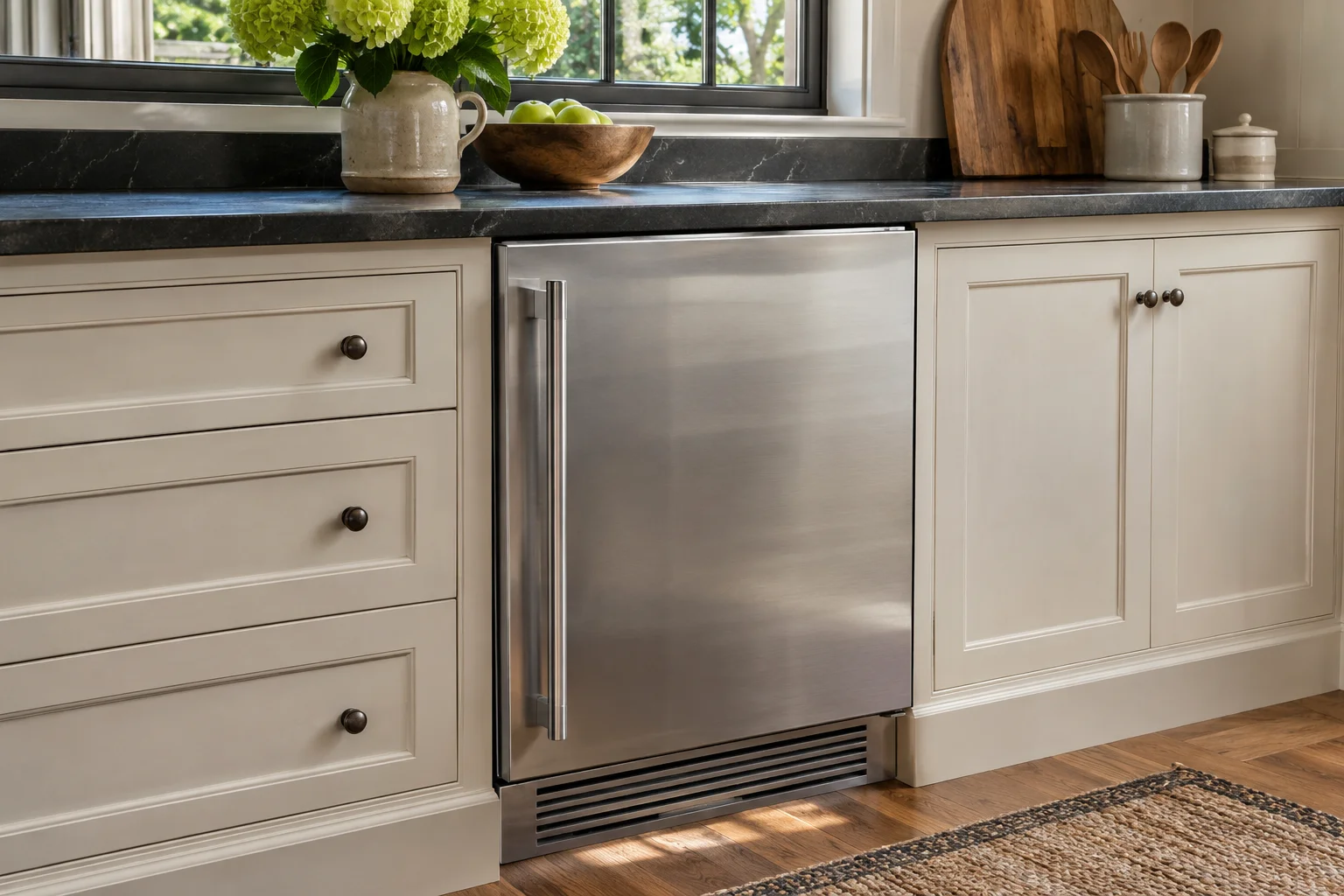
Undercounter equipment has service-access constraints of its own. A photo of the full installation can be more helpful than a close-up of the control display alone.
Describe the refrigerator, freezer, wine cabinet or ice-making function involved. Separate zones and built-in access are useful details to include, without assuming that every Sub-Zero configuration is the same.
Before the visit
Keep the door closed and protect perishable contents with suitable cold storage if temperatures are unreliable. Do not pull a built-in cabinet forward, remove trim or open service panels to prepare for a visit.
Clear a safe working area, keep any displayed message and mention custom panels or restricted access. Do not dismantle the appliance in preparation.
Diagnosis, approval and repair
The diagnostic/service call is $149, credited toward an approved repair. After diagnosis, you receive an itemized repair quote before work begins. Genuine OEM parts are used.
Availability, including same-day or emergency requests, depends on the address and schedule. Sending a request does not reserve an appointment.
The 1-Year Parts & Labor Warranty covers parts installed and labor performed under normal use. It excludes new unrelated faults, misuse, power surges and work performed by others after the visit.
Sealed-system and refrigerant work is performed by an EPA-certified technician. Manufacturer names identify equipment serviced; this is independent service.